The Global Justice Report
Het Wereldgerechtigheidsrapport
Een Plan voor Gelijkheid en Welvaart Binnen Planetaire Grenzen
Thomas Piketty
Co-edited with L. Chancel, J. Dietrich, C. Mohren, R. Moshrif, M. Odersky, O. Somanchi), WIL, 2026, 136p.
Presentatie Thomas Piketty, IPSP, June 25, 2026
Wereldgerechtigheidsrapport: Een Plan voor Gelijkheid en Welvaart Binnen Planetaire Grenzen.
Kunnen alle landen welvaart bereiken terwijl de bewoonbaarheid van de planeet behouden blijft?
Zo ja, wat zou er nodig zijn?
Gelijkheid en welvaart voor iedereen waarborgen tegen 2100
Een nieuwe visie op wereldwijde vooruitgang in de 21e eeuw
Het is mogelijk om planetaire bewoonbaarheid en hoog welzijn voor iedereen te verzoenen — echter enkel als de transformatie tegelijkertijd op drie pijlers rust:
Snelle decarbonisatie - Voldoendeheid - Ongelijkheidscompressie
Onderdeel van een bredere internationale agenda voor planetaire bewoonbaarheid, sociale rechtvaardigheid en hervorming van de mondiale financiële architectuur.
Excerpta uit een interview met Piketty in "De Standaard" (4 juli 2026)
"Rockster-econoom Thomas Piketty heeft een plan"
Observaties en radicale voorstellen
Het Globale Zuiden zal de belangrijkste politieke kracht van de toekomst zijn
Een maandelijks inkomen van €5.000 bruto voor iedereen, overal ter wereld, een 25-urige werkweek, dringend decarbonisatie van de hele economie, een miljardairsbelasting van 20%, een beleid van voldoendeheid.
De structurele transformatie van de economie wordt gefinancierd door een 'Global Justice Fund' dat 10% van het wereldwijde BBP herverdeelt via wereldwijde belastingen op hoge inkomens en vermogen.
Veranderingen op wereldschaal (bestrijding van klimaatverandering en herstructurering van de economie): collectieve mobilisatie is cruciaal.
- De legitieme wens van degenen die in India of Afrika wonen om dezelfde welvaart te genieten als in Europa, moet worden verzoend met klimaatdoelstellingen.
- Wanneer landen als Brazilië net zoveel fossiele brandstof gaan verbruiken als voorheen, zal de geopolitieke vijandigheid toenemen en zal de wereld in verdoemenis zinken.
- Als we niets doen, komen we in veel moeilijkere situaties terecht.
- Een beleid van voldoendeheid en een vermindering van de werkuren voorkomen dat het wereld-BBP te snel stijgt.
- Het migratieprobleem: steeds meer vluchtelingen zullen naar Europa komen als Afrika zich niet snel ontwikkelt, waar in 2100 meer dan 3 miljard mensen zullen wonen.
- Als je fossiele brandstoffen wilt blijven gebruiken, heb je een probleem. We zullen moeten accepteren dat de productie-industrie niet oneindig kan blijven groeien. Iedereen zal altijd een iPhone hebben, maar het zal niet mogelijk zijn om steeds meer elektronische apparaten te gebruiken. Mensen willen vooral een goede school voor hun kinderen, goede ziekenhuizen en goed openbaar vervoer.
- Het dringend decarboniseren en structureel transformeren van de economie vereist enorme investeringen wereldwijd.
- Financiering? Een politieke keuze: een nieuwe internationale instelling, het Global Justice Fund, dat 10% van het wereldwijde BBP herverdeelt met wereldwijde belastingen op hoge inkomens en rijkdom.
- In het mondiale zuiden zal tot 98% van de bevolking hiervan profiteren. Als we ook het welzijn en het beperken van de opwarming van de aarde tot 1,8 graden meerekenen, zijn er bijna geen verliezers meer over.
- Mondiale verandering (bestrijding van klimaatverandering en herstructurering van de economie): ervoor zorgen dat alternatieve scenario's worden overwogen, grote coalities nodig zijn, collectieve mobilisatie is cruciaal.
- In de tweede helft van de vorige eeuw bouwde Zweden een van de grootste verzorgingsstaten ter wereld op. De mobilisatie van de vakbeweging en de Sociaaldemocraten was cruciaal. Deze laatste had een project om de samenleving te transformeren.
- De impact van het Globale Zuiden zal alleen maar groter worden. Op initiatief van Brazilië en Zuid-Afrika wordt een wereldwijde vermogensbelasting onderzocht. Als ook India en Indonesië dit idee gaan steunen, zal China lid worden van het lidmaatschap.
Ondanks Trump, rechts-populisme en techmiljardairs is de lange mars naar gelijkheid op veel gebieden doorgegaan: meer raciale gelijkheid, meer gendergelijkheid, Brazilië en Zuid-Afrika die de vermogensbelasting op de agenda zetten, het mondiale Zuiden wordt de belangrijkste politieke kracht van de toekomst. Dit is een positieve ontwikkeling. Europa moet dit anticiperen.
Een samenvatting van het boek van Piketty & Co
The Global Justice Report
A Plan for Equality & Prosperity Within Planetary Boundaries
hThe Global Justice Report attempts to set out a new vision for global progress in the 21st century: grounding human development and equality in planetary habitability. It explores the conditions under which the world could move toward this horizon and traces an economically and ecologically consistent transition path from 2026 to 2100.
Its main conclusion is simple: it is possible to reconcile planetary habitability and high well-being for all, but only if the transformation rests on three pillars simultaneously. Fast decarbonization of energy systems is necessary. But we also need a major shift toward sufficiency– understood as a sharp reduction in labour hours and material footprint and large changes in consumption patterns, food habits, land use, and forest cover. In addition, neither decarbonization nor sufficiency can be financed and politically sustained without a drastic reduction in inequality of income, wealth and power, both between countries and within them. The compression of global inequality is not only compatible with deep decarbonization; it is a necessary condition for shared prosperity on a finite planet.
The Global Justice Report is the first attempt to propose a fully quantified plan going in this direction, combining four dimensions that today’s debates often treat separately: redistribution at the world scale, a deep reform of the international financial and economic order, a radical transformation of energy systems, and substantial shifts in consumption patterns.
Compared to most climate scenarios, including by the Intergovernmental Panel on Climate Change (IPCC), the main novelty is that we model all four dimensions together and place inequality and sufficiency at the center of the analysis. Concretely: Per capita monthly national income converges to €5,000 in every country, closing a 16-fold gap. The share of the bottom half of global wealth increases from 2% to 30%, while the share of the billionaire class decreases from 6% to 0.05%. Nearly 90% of the world’s population double their income while working roughly half as many hours as they do today. Warming reaches 1.8°C by 2100, rather than over 4°C under baseline macroeconomic and policy trends.
The Global Justice Report is part of a broader international agenda for planetary habitability, social justice, and reform of the global financial architecture– including the Bridgetown Initiative launched by Barbados in 2022, combining international monetary reform, global wealth taxation, and climate finance; the recent Sevilla commitment on development finance; the UN Tax Convention process; and G20 initiatives led by Brazil and South Africa on global inequality and the re-balancing of wealth and power within planetary limits. The main contribution of this report is to place these proposals within a quantified institutional framework, modeling socioeconomic convergence, temperature change, and distributional trajectories through 2100. Our broad conclusion is that it is possible to conceive of a quantitatively consistent plan for sustainable development on a global scale based on proposals such as the Bridgetown Initiative and other recent platforms.
Box 1: Combining Global Equality and Planetary Habitability
The Global Justice Report describes desirable future scenarios combining two key goals: socioeconomic equality (including full equality between countries, full gender equality in labour hours and pay, sharp compression of within country income and wealth scales, combined with fair access to education, health and political voice), and planetary habitability (aligning global resource use within ecological boundaries, including a limitation of global temperature rise below 2°C).
To avoid climate catastrophes, we show that sufficiency is required: a structural transformation of the economy involving shorter working hours, a lower material footprint, a shift from material-intensive sectors toward relatively immaterial sectors such as education and health, and major changes in food systems and land use. Rapid decarbonization of energy systems is also necessary, as is the sharp compression of income and wealth inequality. This compression is both a social justice objective and a condition for financing necessary climate investment and human capital expenditure and for sustaining political support from bottom- and middle-income classes in both the North and the South
Box 2: Material and Monetary Accounting for Democratic Debate
Economy and ecology cannot be debated apart: every economic activity has a material footprint, every ecological policy shapes incomes and wealth. To make these links visible, the Global Justice Report uses multidimensional social progress indicators. We set quantitative targets for global socioeconomic justice by combining two complementary languages: material accounting (work hours, sectoral shares, education and health, energy systems, GHG emissions, land use, forest cover, temperature levels) and monetary accounting (income and wealth scales between and within countries, progressive tax rates). The report draws on two centuries of historical data on global inequality and resource use, and on the recent literature on social progress, climate and colonial reparations.
The Global Justice Report proposes a quantitatively and institutionally grounded step toward global justice. It does not seek to close the debate: it offers a transparent basis on which citizens, unions, parliaments, and international bodies can debate, contest, and decide the course of the coming decades
Global Justice by 2100 at a Glance
- Equality between countries: Average per capita monthly gross national income (PPP Euros 2025) rises to 5,000 Euros in all countries by 2100. Today, it ranges from 290 Euros in Sub-Saharan Africa to 4,590 Euros in North America/Oceania (a 16-fold gap).
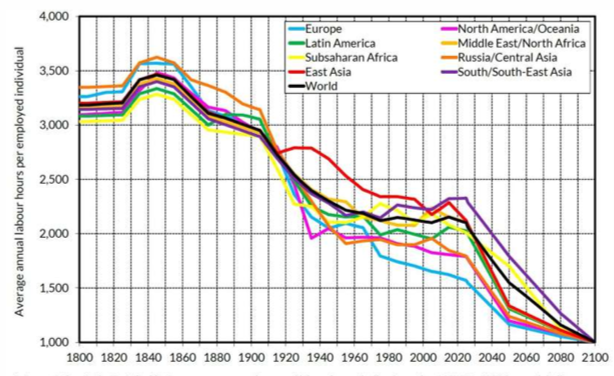
- Less work, more emancipation: Annual labour hours per employed person fall from about 2,100 hours today to about 1,000 hours by 2100, continuing the historical trend toward shorter working time.
- Education and health for all: Per capita education spending rises to 8,400 Euros per year across all countries in 2100. Today, it ranges from 210 to 4,140 Euros. Health spending rises to 14,400 euros. Today it ranges from 110 Euros to 8,300 Euros. The share of global working hours devoted to education and health rises from 11% today to 43% in 2100. Full gender equality: Women and men converge on equal amounts of economic and domestic labour and on equal average pay.
- A world below 2 °C: Warming reaches 1.8°C under sustainable convergence and fast decarbonization, against over 4°C under persistent inequality and slow decarbonization (current policies). Wealth redistribution: The bottom 50% global wealth share rises from 2% to 30% (×15), while the top 0.001% share (billionaire class) falls from 6% to 0.05 % (÷100) – a striking redistribution.
- Inequality compression: The income scale is compressed to 1 to 5, and the wealth scale to 1 to 10. This represents a major compression of global income inequality, on a scale similar to the reduction achieved in Western and Nordic Europe over the 20th century.
- Global Justice Fund: Annual expenditures (including country dividends and investment flows) reach 10.3 % of world GDP per year on average over the 2026-2060 period. In comparison, current official development aid and the combined budgets of the UN, IMF, and World Bank account for less than 0.4% of world GDP. This is justified by the fact that new climate investments alone will represent 3-4% of world GDP per year in the coming decades and will need to be supplemented by a big push in education and health expenditures to foster global convergence.
- World Sovereign Fund: An active portfolio of sustainable assets reaching 10% of the world capital stock (or equivalently, to 60% of the world GDP). Initial asset accumulation comes from reinvesting a large part of global wealth and income tax revenues over the 2026-2035 period.
Ensuring Equality and Prosperity for All by 2100
Work less, achieve gender equality
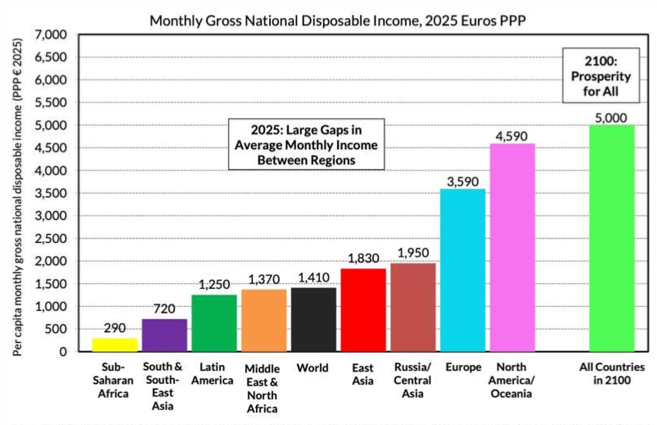
The Global Justice Platform’s basic objective for equality and prosperity is full income convergence across countries by 2100. Today, per capita monthly gross national income ranges from €290 in Sub-Saharan
Africa to €4,590 in North America/Oceania (a 16-fold gap), with a world average of €1,410. By 2100, all countries will converge to €5,000 per mont . This corresponds to a target of €60,000 per capita annually. Achieving this target implies annual GDP per capita growth rates of around 0-0.5% in today’s richest regions (North America/Oceania, Europe) and around 3-4% in today’s poorest regions (Sub-Saharan Africa, South and South-East Asia), the latter comparable to the average growth rate of East Asia over the last 75 years.
There are two main reasons for this target. First, all countries in the Global South aspire to economic prosperity, and any credible framework for global climate cooperation must account for that aspiration. At the same time, convergence to a higher level would not fit within a 2°C carbon budget. The €5,000 target and the resulting growth cap in rich countries meet at the intersection of these two constraints.
Near-zero growth in today’s richest countries does not mean that their living standards stagnate. From the perspective of monetary income alone, a large share of the population in rich countries would continue to see their incomes rise over the next decades, thanks to the sharp compression in wealth and income inequality within countries. Accounting for the value of additional leisure time and the avoided costs of climate damage relative to high-growth and high-warming scenarios, even today’s richest countries will enjoy a substantial rise in comprehensive well-being indicators.
The first element of sufficiency in the Global Justice Platform is a large reduction in working hours: from about 2,100 hours to 1,000 hours per year per employed person, between 2025 and 2100. As observed in historical episodes of working-time reduction, productivity growth makes such reductions possible. Countries have historically used a significant share of their long-run productivity gains to enjoy more leisure rather than to consume more goods, and the mounting threats to planetary habitability now provide an additional rationale for limiting the economy’s material footprint. The required pace is only slightly more ambitious than what occurred over 1860-1980, the peak of working-class mobilization on this issue. Of course, the fact that the projections are consistent with past experiences does not imply that they are easy to implement.
The reduction in working hours relied on very strong collective mobilization and legislative action in the past, and the same will likely be needed in the future. In addition to reducing working hours, all countries converge toward full gender equality in the labour market, with similar employment rates for women and men equal hours of economic and domestic labour, and equal average pay. Gender equality is widely endorsed as an objective among younger generations around the world, much like working-time reduction and the preservation of planetary habitability, but achieving it also requires enormous political mobilization and far-reaching changes in institutions, public policies, and social norms. Equal parental leave, anti-discrimination rules, and gender quotas for promotion need to be systematized and reinforced; more radical tools, including fiscal equalization of incomes between women and men, are likely to be needed to re-balance power relations within households. The compression of the income and wealth scales presented later is also complementary to gender-equality objectives, given the pronounced over-representation of men at the top of these distributions
The reduction in working hours also needs to be accompanied by a significant shift from the material to the immaterial sectors. The share of global working hours devoted to education and health rises from 11% in 2025 to 43% in 2100. Although this increase may appear large, it is worth noting that countries such as Norway and Sweden already allocate around 30–35% of labour hours to these sectors today. Given the scale of future needs in health and education, driven by population ageing and expanding access to higher education among younger generations, even the projected rise to 43% may well turn out to be insufficient.
Staying Below 2°C
- The only way to keep warming below 2°C while achieving our objectives of equality and shared prosperity is to combine sufficiency and a fast energy transition (Figure 5). Sufficiency includes a sharp reduction in labour hours and material footprint, a large shift in consumption from material to immaterial sectors (education/health), and a substantial change in food habits, allowing for a strict deforestation ban and a gradual return of global forest cover to the 1900 level. The transformation of energy systems entails electrification of energy demand, a shift to low-carbon fuels in sectors such as steel and cement, and the decarbonization of electricity generation. Only a rapid and urgent decarbonization can bring the share of fossil fuels to under 20% of global energy demand by 2050 and to zero before the end of the century, with electricity accounting for nearly 80% of total energy demand and generated entirely from low-carbon sources by mid-century. This requires massive investment in new infrastructure, around 3-4% of world GDP annually over the next three decades, primarily financed by the global rich, who benefited disproportionately from global economic growth in recent decades and bear a major responsibility for historical emissions.
- Only through the combination of sufficiency and an energy transition can humanity stay below 2°C. Otherwise, the world is heading for a climate catastrophe, with global warming above 4°C by 2100. In particular, under current policies, fossil fuels still meet roughly half of global energy demand in 2100. Under current pledges, they still meet around 40%. We also find that targeted sufficiency can be more effective than aggregate degrowth. For instance, a €60,000 per capita GDP target with a large consumption shift to immaterial sectors, change in food habits, and implied reforestation leads to a temperature rise of 1.8°C in 2100, i.e.less than the 1.9°C associated with large uniform degrowth (€15,000 for all-in 2100) but without sufficiency and structural transformation.
Building the Global Justice Platform
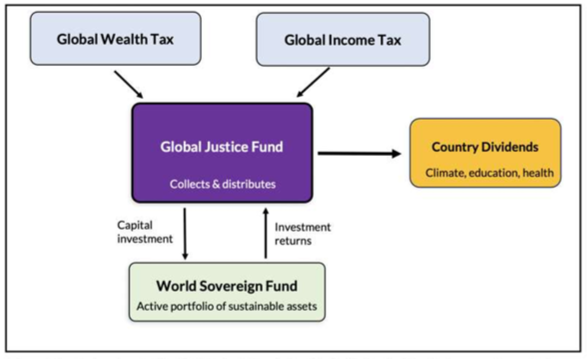
- Le Fonds mondial de justice (GJF) est le pilier de la Plateforme mondiale pour la justice et l’institution clé responsable de la résolution de ces défis. Il est conçu comme une nouvelle institution internationale dédiée à la convergence socioéconomique mondiale et au financement du développement durable ainsi que de la transition énergétique à l’échelle mondiale. Son objectif principal est d’assurer des opportunités de développement équitables pour tous les pays tout en limitant le réchauffement climatique à moins de 2 °C.
- Le GJF est responsable de la collecte de recettes adéquates (via l’imposition mondiale de la richesse et du revenu), de la gestion d’un Fonds souverain mondial (composé de recettes fiscales précédemment accumulées) et de la distribution des dividendes nationaux (attribués à chaque pays sur une base égale par habitant et utilisés pour financer les investissements climatiques, l’éducation et les dépenses de santé). Les impôts mondiaux sur la richesse et le revenu s’ajoutent aux systèmes fiscaux nationaux et ne ciblent que la répartition la plus élevée du monde, soit environ 1 % de la population mondiale.
- Dans les premières années de la plateforme, l’impôt mondial sur la richesse effectue la majeure partie du travail, captant des paiements substantiels des milliardaires, centimillionnaires et décamillionnaires du monde entier et les canalisant vers le Fonds souverain mondial. Le Fonds accumule des actifs équivalents à environ 60 % du PIB mondial, soit environ 10 % du capital social mondial, et se stabilise autour de ce niveau (Figure 9). Une fois construit, les revenus issus de ces actifs remplacent progressivement les recettes fiscales comme principale source de financement de la plateforme : d’ici 2050, les revenus d’investissement représentent déjà les trois quarts des ressources du GJF ; en 2100, elle les représente tous.
- Côté dépenses, les dividendes par pays sont répartis de manière égale par habitant et représentent donc une part plus faible du PIB dans les pays riches que dans les pays pauvres, soit en moyenne environ 2 à 3 % du PIB en Europe et en Amérique du Nord/Océanie entre 2026 et 2100, contre 5 % en Asie du Sud et du Sud-Est et 9 % en Afrique subsaharienne. Ils s’accompagnent de conditions fortes : objectifs climatiques (investissement énergétique bas carbone, émissions vérifiables de gaz à effet de serre, fin de la déforestation), objectifs de capital humain (dépenses d’éducation et de santé) et objectifs d’inégalités (répartition des revenus et de la richesse). Au-delà du financement des dividendes des pays, le Fonds souverain mondial remplit également un second objectif clé : une participation publique permanente d’environ 10 % du capital social mondial, contribuant à la réorientation des investissements mondiaux vers le développement durable.
Funding It at the Right Scale
Annual expenditures of the Global Justice Fund average 10.3% of world GDP per year over the 2026-2060 period. This vastly exceeds the total combined resources currently allocated to development aid and international organizations (less than 0.4% of world GDP). This is because the scale of the challenge is unprecedented: climate investment alone amounts to 3-4% of world GDP per year in the coming decades, and the GJF also needs to help finance human capital expenditure to foster global sustainable convergence . A central objective of the Global Justice Platform is equal access to high-quality education and health for all. Total education and health spending rises from 13% of world GDP today, with very large disparities across regions, to about 38% of world GDP everywhere by 2100. The Global Justice Fund finances the early push: between 2026 and 2050, it helps poor countries close the most extreme gaps in education and health spending. Per capita education expenditure today ranges from €210 in Sub-Saharan Africa to €4,140 in North America/Oceania, a gap of 1 to 20, and health expenditure ranges from €110 to €8,300, a gap of more than 1 to 70. By 2100, all countries will converge to €8,400 per person for education and €14,400 for health, but this will take decades to achieve equal access to education and health. By 2050, education and health gaps are still projected to be around 1 to 3 in our benchmark scenario.
This reflects the fact that the Global Justice Platform is a relatively moderate, gradualist platform (arguably too moderate and gradualist). Bringing immediate equal access to today’s rich-country levels of education and health would require a Global Justice Fund roughly four times larger, around 40% of world GDP, rather than 10%. Our benchmark proposals trade off ambition against political feasibility and are open to scaling up.
Compressing the Income and Wealth Scale
The Global Justice Platform aims at substantial compression of national income and wealth scales over 2026-2100. Global wealth and income taxes are designed both to raise the resources needed by the Global Justice Fund and to curb the concentration of income, wealth, and power at the top of the world distribution. Country-level policies (progressive taxation, minimum wages, pay-scale regulations, labour market rules, workers’ representation on corporate boards) are expected to play the leading role in reshaping each country’s income distribution in the long run. The income scale within each country is projected to converge to 1 to 5 by 2100; the corresponding steady-state wealth scale to about 1 to 10. The combined effect of between-country convergence and within-country compression brings the share of the global top 10% in post-tax income from 52%todaydownto18%in2100,while the bottom 50% share rises from 8% to 38%.
The wealth picture is even more stark. The share of the bottom 50% of the world’s wealth distribution rises from about 2% today to about 30% by 2100, a 15-fold increase). The wealth share of the world’s billionaire class falls from 6.4% to 0.05%, a decline of more than a hundredfold.
The projected compression of the income and wealth scales is consistent with the long-term trends observed in some of the richest countries in the world, particularly in Western and Nordic Europe. For instance, the ratio between the post-tax income threshold of the 99th percentile and that of the 10th percentile (P99/P10) declined from about 32 in 1900 to 3.9 in 1990 in Nordic Europe, and it is projected to decline from about 37 on average today at the world level to 3.3 by 2100.
History suggests that this kind of compression does not come at the expense of prosperity. The countries that experienced the most substantial reduction of top-end inequality in the twentieth century (Nordic and Western Europe) are also those that experienced some of the most impressive productivity gains. The United States, where top inequality rose markedly after the 1980s-1990s, did not enjoy faster productivity growth than Western and Nordic Europe over the same period.
Building National and Global Coalitions
- A vast majority of the population (about 95–98% in the Global South and 85–95% in the Global North) benefits from the Global Justice Platform in purely monetary terms. At the global level, 89% of the population sees their annual monetary income more than double between 2025 and 2100, while less than 2% experience an income decline. In the poorer regions, gains are nearly universal: about 99% of the population sees more than 100% growth in monetary income, with virtually no income decline. In the richer regions, the gains are smaller, but the majority still benefit About 45% of the population in North America/Oceania and 28% in Europe at least double their monetary income; a minority (14% in North America/Oceania and 6% in Europe) sees their monetary income decline. Those losing out sit essentially at the very top of each country’s income distribution. The bottom and middle of the distribution come out ahead, both through rising monetary incomes and through better-funded education and health systems financed by country dividends.
- These material benefits come on top of important non-monetary ones: more leisure, less warming, a financed energy transition, and curbing the destabilizing effects of extreme inequality. Once the value of leisure and planetary habitability is taken into account (with all due caution), more than 99% of the world’s population is better off in 2100 than today, including in the richest regions. only from the ultra-rich. In rich countries, between 10% and 20% of the population would be on the margin of losing out, especially when comparing their situation to alternative high-growth, high-warming trajectories. They could be persuaded that sufficiency, free time and planetary habitability are not worth the trade-off. The cultural and intellectual battle is therefore not only about the taxation of billionaires and multimillionaires; it is also about the value we place on sufficiency, free time and planetary habitability themselves, and the end of “classless ecology”.
Building a Democratic World Order
The Global Justice Platform requires not only the creation of the Global Justice Fund (GJF) but a broader transformation and democratization of the international economic and monetary system. The GJF itself should be conceived as a new international institution, governed by strict rules of democracy and transparency, with regular budgetary decisions taken under a double-majority rule: 55% of countries representing 60% of the world’s population.
This stands in sharp contrast to today’s plutocratic system. At the IMF and World Bank, GDP-based voting gives Europe & North America/Oceania roughly four times their share of the world population. At the same time, South & South-East Asia and Sub-Saharan Africa hold only about a quarter of theirs. The Global Justice Platform proposes a transition to one-person-one-vote, immediately or at the latest by 2050. Beyond the GJF, this implies broader reforms of the international monetary and trade system, including the creation of an International Clearing Union and the transformation of the IMF into a United Nations Central Bank that issues a new international reserve currency to end exorbitant financial privileges.
To a large extent, the current global plutocratic system resembles the wealth and income-based voting systems that were applied in many countries in Europe and elsewhere in the 19th century and up until the early 20th century (including countries like Sweden, where inequality was at the time deeply embedded in the political system). The shift from global plutocracy to global democracy, which we envision for the 21st century in the context of the Global Justice Platform, has the same status as the shift from national plutocracy to national democracy that occurred in the 20th century. It is both a goal and a means.
The Global Justice Platform is based on forward-looking universalist principles, with equal per-capita country dividends for all countries and identical tax schedules everywhere: all billionaires pay the same, whether they come from the North or the South. Because country dividends account for a larger share of GDP in the South, and the global rich predominantly come from the North, the Global Justice Platform (GJP) also implies a form of class-based reparatory justice. In practice, however, the North-South transfers implied by the GJP are relatively modest: about 0.8% of world GDP per year over the 2026–2100 period. This is significantly less than the magnitude of annual transfers that would be required to compensate for the cumulative colonial and climate damages imposed by Europe and North America/Oceania between 1800 and 2025 (about 3%). This suggests that the GJP would need to be scaled up to fully account for historical responsibilities and to better approach universal, equal access to education and health. The scaling up could come from more progressive tax schedules and country dividends, or by direct reparations supplementing universal policies.
If necessary, the Global Justice Platform can be implemented with an incomplete coalition of countries, including the absence of the US and/or China. According to our projections, the climate damages imposed by the US on other countries would be about 3% of world GDP per year, on average, over the 2026-2100 period if the US does not participate in the GJP. Under simplifying assumptions, other countries should impose a corrective tax of approximately 80% on all US exports to collect tax revenues approximately equivalent to the damage. Given the projected decline of the US share in world GDP– from 30% in 1945 to 15% in 2025 and 5-10% by 2100– it is likely that such tariffs would induce the US to join the GJP. The same conclusion applies to the case of China, but with a higher tariff (180% or more).
Kortom, het Global Justice Report stelt dat een leefbare, gelijkwaardige 21e eeuw materieel mogelijk is. Het koolstofbudget maakt het mogelijk, en de geschiedenis biedt precedenten op vergelijkbare schaal, van de opkomst van algemeen kiesrecht tot de universaliteit van gezondheid en onderwijs en de afname van ongelijkheid in de 20e eeuw.
Wat in de weg staat, is niet een technisch onmogelijkheid, maar politieke keuzes en het harde maar cruciale werk om er een coalitie achter te bouwen.
Circulaire Know-How Economie Afrika-Europa
11/07/2026 karel.uyttendaele {@} pandora.be
Verwante blogs
Een Afro-Europees "1 000 kmo-initiatief” & Afrika’s Gen-Z
Alle Afrikaanse ambassadeurs promoten de kansen geboden in gans Afrika
Afrika is NIET wat u gelooft. Een gestuurde mentaliteitswijziging van heel Europa
Een Mandela-Schuman Afro-Europese Gemeenschap Energie-Intensieve Industrie
Industriële métissage mét Afrika: kantelend Europa verwerft geopolitiek terug een stem
Trump-Klimaat-Biodiversiteit: kantelpunten Afro-Europese sociaaleconomische doorbraak
Heeft Europa nood aan historisch lage energiekosten als buur Afrika bulkt van groene energie?
Maak jouw eigen website met JouwWeb